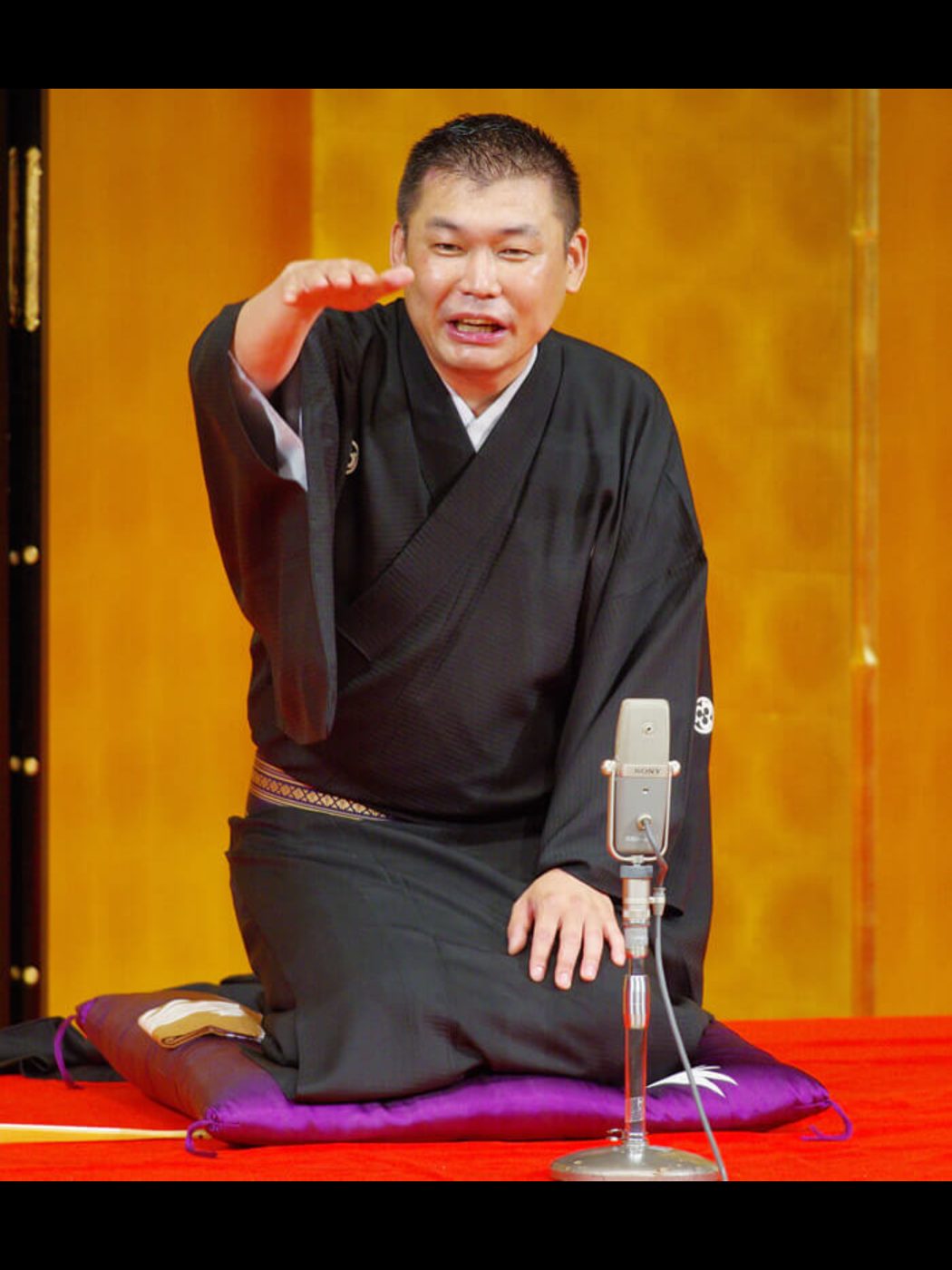
Rakugo is Japan's traditional comic storytelling — one person, seated,
playing everybody in the story with nothing but a fan and a hand towel.
It also happens to be built out of the things a language learner needs.
Japanese is usually taught as a set of tables to memorise: this form for someone above you,
that form for a friend. Rakugo does not teach it that way, because
Rakugo cannot be performed without doing it. Five reasons, in order.
01
Almost all of it is conversation
Textbook Japanese is expository prose. Rakugo is one person talking to another, beginning to end.
We counted the pieces a beginner starts with: narration comes to about a tenth. Everything else is somebody's line.
Not Japanese to be read — Japanese to be exchanged, sustained for the length of a whole piece.
02
Kamishimo — politeness becomes a direction
This is the part no other Japanese material has.
One performer plays every role, so the roles are told apart by which way the body turns.
Speaking to someone above you, the performer faces one way; answering from below, the other.
The register is not recalled. It is turned toward.
So the learner is not deciding which form to use. They are turning their body,
and the form follows. Politeness stops being a table to learn and becomes a place to stand.
03
If you laughed, you understood
Every piece ends in a sage — the turn that lands.
Laugh, and the meaning arrived. Don't laugh, and something is still missing.
No test is needed; the learner notices it themselves, in the room, in the moment.
It is the fairest comprehension check we know, and a child can read it without help.
04
Rehearsal is not finished until it is said aloud
Reading it through does not count.
Rakugo is performed, so it is always spoken. The familiar gap — can read it, cannot say it —
has a harder time opening up when the only way to finish the work is out loud.
05
The same phrases come back, because they are funny
Rakugo repeats on purpose.
The recitation in Jugemu; the parroting back and forth in a two-hander.
Flashcard repetition is dull, so it stops. Rakugo's repetition is funny,
so a learner says it again, and again, unasked — and set phrases arrive
already worn smooth by use.
Three layers, one form
Layer
What it covers
Where it happens
Sound
Pronunciation, pitch accent, rhythm, and ma — the pause
Working from the correct reading; the recitations; the tempo of a two-hander
Words
Vocabulary, turns of phrase, register and how to address people
The lines themselves, and the switch of kamishimo
Culture
Seasons, annual customs, daily life, old Edo
The makura opening, the background of the story, the culture note each week
A fuller research note — the teaching procedure broken into seventeen distinct acts,
each checked against the existing literature, with figures, tables and twenty-two references —
is published here.
For schools that teach Japanese
I perform online for your students, free of charge. Thirty minutes:
twenty-five of storytelling, then five in which the students say a short comic story
out loud together, with the gestures. Everything over Zoom. Nothing to prepare.
In Japanese, or in English — I have performed Rakugo in English at Carnegie Hall
and Harvard University, so students can follow it at any level.